Showing posts with label astronomy. Show all posts

June 30, 2012

Uranus, Neptune, Pluto and making a cloud


Uranus and Neptune are also gas giants like Saturn and Jupiter. They are blue because of the methane gas in their atmospheres so we made our background paper color two shades of blue. One shade for Neptune the other for Uranus.


The next chapter and the last one for us this year is on Pluto and the Kuiper belt. We have been using Jennie Fulbright's text Exploring Creation through Astronomy.


There has been a big debate whether of not Pluto is a comet or a planet. Officially it is now a comet, but we looked at the evidence and I gave the boys a chance to vote for themselves...they voted that Pluto is a planet, I think it is a comet. What do you think?


How to make a cloud in a jar
  1. add warm/hot water to a jar.
  2. light a match and top it in.
  3. place a ziplock bag with ice in it over the opening of the jar and seal the opening closed.
  4. watch the cloud form.


This T.J's final map drill of the planets. Great job Guys!!

And that is all for our astronomy studies this year....we are already onto looking at birds and insects.


April 24, 2012

10, 9, 8, 7, 6...BLAST OFF!

We made these cool looking rockets out of a piece of contruction paper, tape and some felt pen decorations. Hidden inside of these fabulous rockets is a clear film canister. Today we are attempting to launch our rockets into space.

The film canister we filled with warm water...then quickly and I mean quickly we dropped the alka-seltzer tablet into the canister and put the lid on.

Then we waited for it to shoot up into the air...

But the most we got was a little 'pop' and then the rocket fell over. As T.J. oberved the 'failed' launches of his brothers rockets and saw how wet they got he would not even give his a try. He was too proud of the rocket he had made to see it get ruined. Maybe another day T.J.

April 3, 2012

Astronomy Catch Up

Well I am about three chapters behind in chronicling our events in Astronomy. We have had a lot going in our neck of the woods and we also plan to do some traveling soon, so here is a very short nut shell version of our recent pages and project.

Space Rocks Title page by Max 
Each time we begin a new set of pages we try to think of a color or in this case a way to decorate the page so it reminds us of the planet we are studying. We had alot of fun splattering paint to make these pages.

Space Rocks Title Page by Zak
Two page Spread by Zak

Space Rocks Title Page T.J.
Two Page Spread of Jupiter by Max

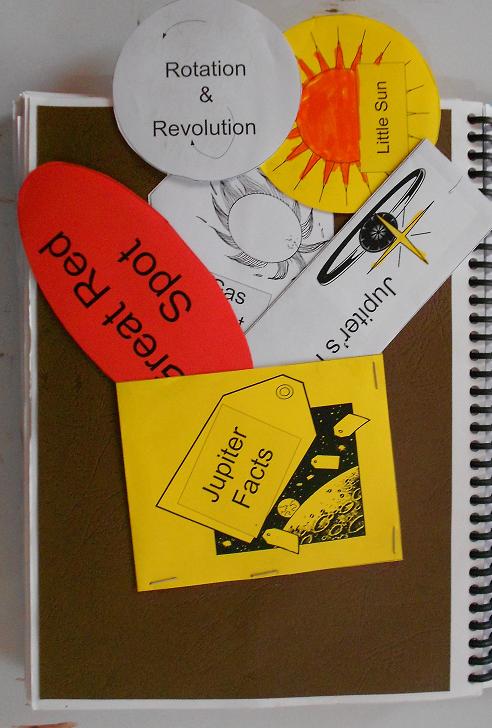
Jupiter Fact Pocket by T.J.


 Saturn Two Page spread by Zak
 Because Jupiter and Saturn both rotate so quickly they have strong winds, or hurricanes. We made this hurricane in a bottle to see how this happens.

All of our lapbook mini books came from these two sources:


And the solar system map drill which we do at the end of each chater is found here.

February 23, 2012

The Stars and Their Stories

The last day of our week is sort of a catch up day or a fun day. It is the time when we do map drills for Egypt and when we read about a mathematician instead of doing math problems from our book. It is also the day that we have been reading about Galileo and learning more about the stars. First we read about Galileo using these books:
Now we are reading through a public domain book called The Stars and Their Stories. It is full of poems that could be used for copy work, and the stories from Greece about how the stars got their names for narration. I am so excited about the stories for they introduce our study of Greece and Rome next year so beautifully. To be able to have a hands-on element in the lesson I created an interactve pocket that goes with a set of notebook pages that follows along with each chapter. Each page allows space to write a short something about the story and the hands-on activity gives the boys a chance to map out the stars with a push pin and hold it up to the light to see the star patterns of each constellation. The velum pocket holds it all together on one page.

The page.

The punching out.

The looking.

After they have punched out the holes then we trace the line between the stars to reveal the pattern more clearly. Then label it and put it in the pocket.

Download the pages here.

February 5, 2012

To The Moon!

Zak's coloring of an Astronaut on the Moon.
We have had a wonderful exploration of the moon. We found out we weigh less there. The boys were so impressed by the fact that a man has actually set foot upon that far away place, not to mention the amazing fact that the footprints that were made back in 1969 are still there!


The top book is simply a blank mini book to write facts we had learned about the moon, it has craters, it is white etc.

The Moon Poem by Robert Louis Stevenson is from The Moon Lapbook. On the back of the poem there is a blank sheet for copywork. I could not find the lapbook again so I could link to it. Sorry. :(

The boys all weigh about 46 pounds here on earth....that is about 6-8 pounds on the moon. Wild.

This little flip book is simple to make. We just cut it out and them put the pages in order. When you flip it the moon travels around it's orbit of the Earth.

  • The cool velum pocket on the left has me thinking. It looks great, and the velum folds so nice and clean. You will see us using this medium more in future pocket features. I love them!
  • The phases of the moon worksheet can be found here.
  • The best advantage to this book format for our lapbook base is that we can add notebooking pages whenever we like. I love the freedom this allows.
  • We attampted to track the moon for a month with the card inside the envelope, but several of the days it wasn't visible excpet in the middle of the night, and on other days it was cloudy, so we could n't see then moon then either. So, we packed it in and went on to investigate mars.

We also read the following short picture books about the exploration of the moon to top off our look at this part of creation.


We made a rickety homemade telescope out of two magnifying glasses and a mailer tube. It worked ok for looking but it wasn't all that strudy to last for more than a day. Plus the boys had already discovered that if you aim your magnifying glass at a blank wall at just the right distance you can see and upside down picture of the window or doorway. Pretty cool!

And last but not least, we completed yet another solar system map adding on the moon orbiting around the earth.

January 21, 2012

Planet Earth


Zak as planet earth in our rotate and revolve exercise a few months ago.

We have been having a fun time with our unit on planet earth. Is it not amazing how perfectly it is designed? Our text is still Exploring Creation with Astronomy by Jeannie fulbright. I first read them the chapter from this book about the earth and we have discussions/narrations as we go along. Then next lesson we begin reviewng the information we read about with the following notebook pages which have been made to look like the earth. Our mini books are placed upon these pages. It may take a few lessons to fill them all in and color them but it gives us a nice way to go over the material in the lesson again. If there are demonstrations or experiments we do those as well. This unit we lit a lamp (the sun) and placed it upon the table. Then on the four walls around the table with the lamp I placed a card with one of the four seasons written on it. You can imagine what we did next. I then tilted a blow up earth ball with the hemispheres devided by a black line we drew with a peranent marker, so it was summer.Thus the light was shinning of the southern hemisphere. Then I walked the bow up earth ball around the lamp and stopped at each wall to show what each season would look like. In this way we coudl see more clearly how the tilt of the earth made the seasons.
Have a look at our notebook pages.


Before we added the mini books this time the boys colored the blue paper with some green paint or marker pens to create a background that looks like the earth.

The perfect land game has cards like Montessori cards. You match the label to the picture.

One of Max's Pages

One of Zak's pages.
Because I want them to be thinking about astronomy and not working on fine motor skills, I am still printing out and cutting up all the mini books.

One of T.J.'s mini books.

All of our mini books came from these two sources:

 A Journey Through Learning: Apologia/Jeannie Fulbright Exploring Creation with Astronomy Lapbook B&W
and
Knowledge Box Central » Exploring Creation With Astronomy - Lapbook Lessons 1-6

To wrap up our unit on the planet earth we painted this world map and added glued o labels for the perfect attributes we learned about. This is Max's perfect earth.


T.J.'s perfect earth.

And last but not least Zak's perfect earth.

we can't complete the unit yet without doing a solar system map drill. Get your free copy of it here.

Thank you for stopping by. Visit us again soon for we are going to the moon.

December 22, 2011

Venus it's hot, hot, hot

Venus title Max


Zak's map drill adding in Venus
Venus is the third planet we have studied so far. We began with the sun, then mercury and now venus. It is a very hot planet and full of volcanos so we decide the pages out to look a bit hot, so we chose orange to shwo this. (We are saving red for Mars).

Our Volcano experiment. Photo taken by Max
We only did one experiment this chapter. It was a very easy one using flour, melted butter a small bowl and a tray. Butter melted flowed down the flour mountain we created much the way lava does on the volcanos on Venus. Then as it hardened we could see how the planet was formed.

Two page spread in Zak's book.

The phases of venus are similar to the phases of the moon.
 
Max's drawing of Mariner.
What we know about venus today is largely due to the voyages of the unmanned spacecrafts of Mariner.
 
Max's drawing of venus and the earth.
Long ago, people believed that venus and the earth were twins. But because of the umanned space crafts who vayaged out into space, we know that venus is covered with a  gaseous atmosphere that makes it uninhabitable for people. Though it is about the same size as the earth it is very different than the earth. They are not twins.
 
Zak's title page.
Venus was a fascinating planet. But now we are onto our investigation of our own world, planet Earth. See you soon!
BTW all or mini books came from these two lapbook packages:
(I waited until currclick had their year end sale and bought them half price.)

October 17, 2011

Landing on Mercury

In the spirit of the Magic School bus we rode through the solar system this week and landed on Mercury. We left earth over a month ago after a brief introduction to what astronomy is and can be, and then took a long look at the sun. I know you are not supposed to do that. We used our special goggles designed for exploration of this sort and saved our precious eyes. This week and last week we were on Mercury.  It was very hot, and very cold and very dusty. Once we got home we put these pages together to remind us what we learned about the planet of contrasts.

Here is a look into T.J's astronomy notebook.
The page on the left contains pictures from our activities when we were learning about the sun. On the right is Mercury at night. Due to the lack of atmosphere this planet is a very cold -300 degree Celsius at night. And BTW night lasts here for roughly 59 days.
Another look into T.J.'s book.
This is mercury during the day. It is very very hot due to it's being the planet closest to the sun. The day here also lasts 59 days. The mini books for these two pages were from A Journey Through Learning lapbook package and Knowledge Box Central lapbook  package both geared for direct use with Exploring Creation with Astronomy by Fulbright.

To remember just where our trip led us, we drew mercury on our map.

To understand how mercury got so many craters and how they were formed we dropped different size rocks into a pan of flour. With the left over flour we did the following....


Using the flour from the crater activity we made salt dough. With a little black powder paint added we made replicas of the planet mercury.

Zak holding his mercury model.

And that is all for this week...next time Venus!