We have been painting and listening to Vivaldi's Four Seasons these past few weeks. I have always loved to paint, draw or create with music playing, so it was fun to do this with the boys for these lessons. They did a great job picking a theme to paint for each season and drawing the picture and painting it all by themselves. We began with Summer....
We are getting know three composers this year, beginning with Vivaldi, then Pagani, and ending the year with Wagner. This post by Jennifer Spencer encouraged me very much last year and gives a wonderful explanation of how a composer study can help our children really connect with the composers and their music.
"First, in order to help my students form a relationship with the real person behind the music, I decide to only choose composers for whom there were living biographies available." -Jennifer Spencer
We have always loved Opal Wheeler's books as they give us a heart warming view of the composer as a child growing up which all children can connect with. This year I did not find a book by OW for Vivaldi but I did find one for Pagnini and Wagner. Our living story about Vivaldi will be from the Vox Master collection of CD stories. This one is called The Stories of Vivladi and Corelli.
"The decision to study one work for the term instead of sampling songs or movements from different works was made as a kind of experiement. I based it on the desire to connect with the ideas through the narrative." -Jennifer Spencer
We decided to study Vivaldi's Four Season this term, Another from Paganini next term and one from Wagner the following term. I am not as musical as Jennifer is but we are listening to the music with the idea that there are picture or ideas to be out into our minds. For the four seasons we listened all the way through the entire piece as the boys played quietly with their toys. Then during the following weeks we have been painting a season picture to go with the music. Here is an example of summer by Zak.
"The beauty of the music depends upon the quality of the ideas expressed, not just the technical skill of the performer or the emotional experience of the listener." -Jennifer Spencer
We do this lesson twice a week so we spend about three months with each composer. We also add each composer to our composer lapbook we started two years ago.
We began our composer study like we always do by reading Opral Wheeler's story about him when he was a young boy and then how he grew. The book was entitled Handel at the Court of Kings. The boys were not very inspired to color any of the coloring pages as I read this time. Instead they fiddled with Legos and Uber Stix. They did however enjoy his music alot. I played a complied CD of Handel's music for them as they drifted off to sleep at night.
After we had learned a bit from Handel at the Court of Kings about Handel, we listened to classical Kids production of Hallelujah Handel which contains snippets from many works created by Handel including parts of the Messiah.
The Messiah is my favorite classical piece of all time so I found a free version of it online and played that for the boys. We tried to count how many Hallelujahs were in the Hallelujah Chorus. Then I showed them a you tube video of the Philadelphia Opera Company singing in Macy's around Christmas time. Very cool!
The lapbook we began last year and we are slowly working on it. Each time we look at a composer we add him to our timeline.
Once we place Handel on the timeline we can add his picture to a mini book on the inside of the lapbook.
Then we filled out the biographical info on the inside.
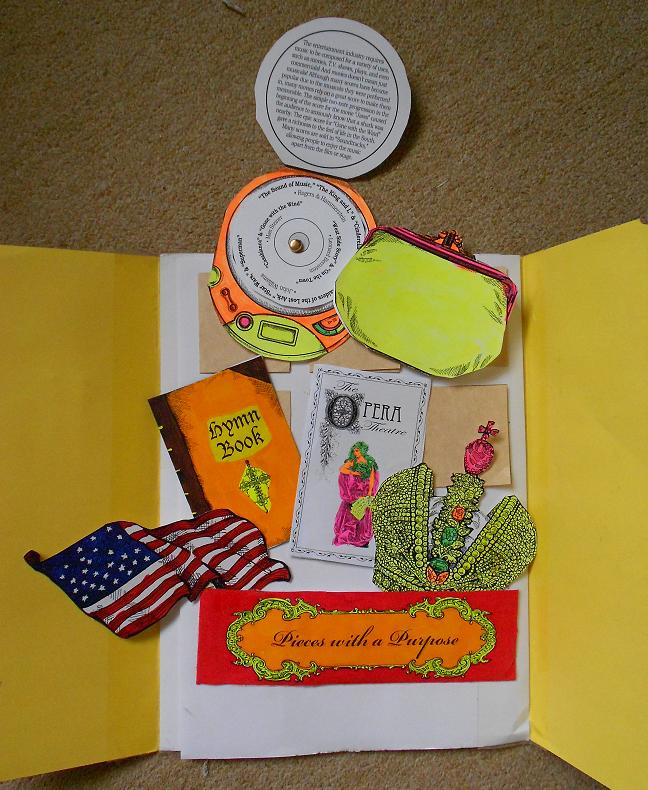
Handel was a good composer to introduce 'pieces with a purpose' one of the hands on activities in this package because he was a composer who wrote so many different kinds of musical works. So while the boys colored and cut I played Hallelujah's Handel again.
Each of these small mini books describes the varying reasons composers wrote music.
Composers wrote to entertain: the CD player and the Opera program. They also wrote to honor a king or Queen thus the crown. They also wrote song of nationalistic nature: the flag mini book represents this. Many composers wrote songs of worsip for the church: the hymnal. And lastly composer wrote to make money: the purse.
Last, but certainly not least we listened to a song called "The Rejoicing" which was included in the Hands-On-Activity pack and filled out an appreciation sheet. The picture of the bottom of the page is a picture Zak drew while listening to the pieces of music.
We have been listening to music by Mozart for years. I compiled an MP3 CD with his music and we play it often as the boys go to sleep. Of all of the choices we have, Mozart is one of their favorites. When we began this composer's study, we knew we liked Mozart's music and already had an appreciation for it, so my main goal in this composer study was to get to know Mozart as a person and to take a close up look at one of his operas.
Last year I purchased a package deal of Opal Wheelers biographies of famous composers. I am still glad I did. The coloring pages and the music on CD have been very useful to us. While I read from the book, Mozart the Wonder boy the boys work on coloring pages, two from each chapter which they colored with felt pens or water colors. They can listen for hours if their hands are kept busy.
I love how all of Opal Wheelers stories of the composers begin by telling us about the lives of the composers as children. We read about how they grew up and what people were in their lives. We learn about their families and what kind of children they were. We can see if they had a good life like our own or if there where difficult thigs in it. Her way of telling their stories makes it easy for my boys to picture themsleves in the lives of these little geniuses and see them as real people with family and troubles etc. Knowing more of the realities and personalities adds so much to the understanding of the music we are enjoying.
After reading Mozart the Wonder boy, we filled out a biography notebook page about Mozart and said what we liked about him. (his music of course!) We put him on the composer timeline to see when he lived compared to Beethoven and Bach whom we learned about last year.
Zak's Lapbook cover
Also,we added his picture to our mini book in our composer lapbooks which we began last year.
I read to them a picture book I found at Goodwill for 69 cents entitled Mozart Tonight. Which is a richly illustrated book that takes us behind the scenes on the night Mozart is to perform the opera Don Giovani. The story fills in the gap where opal wheeler leaves off and tells us more what he was like once he grows up and marries. It was also a wonderful introduction to our look at the opera The Magic Flute by showing us what an opera is and what all goes into performing one.
Once we completed many coloring pages and had a grasp on the flow of the life story of Mozart, we turned our attention to Mozart's last work, the opera entitled The Magic Flute. I used Classical Kids Mozart's Magic Fantasy to introduce them to the opera. We haven't listened to an opera or seen an opera before so I was thrilled when the boys REALLY enjoyed this production of it. They really like the birdman character and so we did a few activities with him.
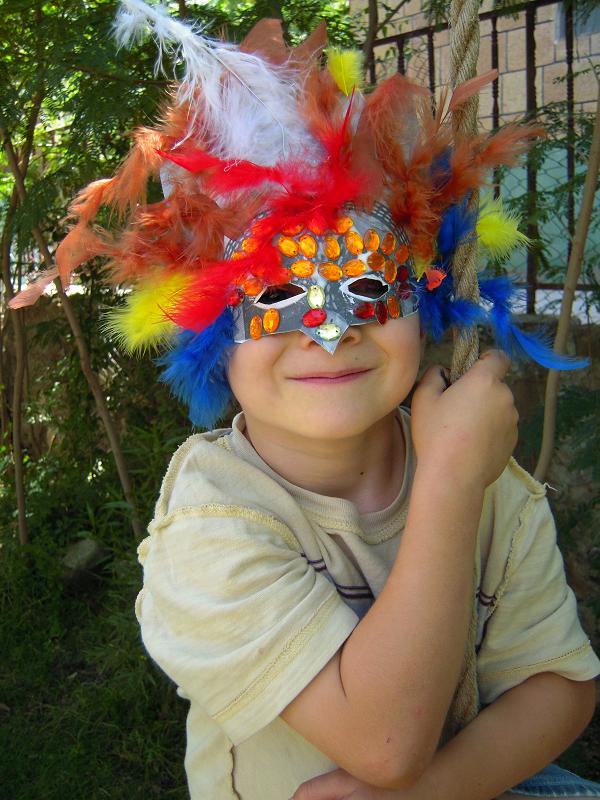
First of all we made bird masks. And we learned the birdman song. Then the boys put on their bird masks and lip synced the song. So cute! Here is T.J.'s video
From one of my digital copies of "The Tutor" I found a 'story' of the Magic Flute which we read through and narrated and then did some copywork of their narrations. I wrote down on a white board what they remembered about the birdman, and then they copied it onto the notebook page. There is a notebook page for the birdman and one for the queen of the night.
For fun to end our study of Mozart, we ate cookies and cocoa and listened to the whole production of Mozart's Magic Fantasy from start to finish with out any breaks. (When we listened to it the first time I broke it into smaller sections so we could talk about what was happening in the story etc. We did one section, maybe half of an hour, twice a week until it was completed.)
If you ask the boys before we did this study on Mozart they would say that He was their favorite composer...now after the study HE STILL IS their favorite composer. What is it about the music of this young man who endears himself to us so well?
BTW One of the best spots on the internet for getting ideas and finding resources for a Mozart composer study is Jimmie's Mozart lense. And....she has pages and pages of these wonderful lenses for just about any topic you may be studying. Check out her lense master page. I just them!
Today we made bird masks. The masks were inspired by the birdman's song in Mozart's opera The Magic Flute. We have been listening to Classical Kids version of the opera and the boys fell in love with the birdman,Papageno. They wanted to learn his song and to go along with the song of course you must have a mask. An opera with out a mask is no opera at all.
T.J., Zak, Me, and Max
I even got in on the fun and made a mask for myself.
Max's Mask
We each picked out a different mask pattern. Max chose this pattern.
This year we are getting to know Mozart, Brahms, Handel, Mary Cassatt, Paul Cezanne, and Augustus Renoir. In addition we are still investigating the instruments of the orchestra and learning to draw. I am not making many changes to how we go about it so the methods we used last year are the same this year we are simply continuing on. Posts from last year are:
For composer study we like to begin by reading biographies by Opal Wheeler, Mozart the Wonder boy, Handel in the Court of the King and The Young Brahms. The study set we purchased came with coloring pages from the charming illustrations in the book and a CD of music that is also introduced in the story as we read it we listen to the music the composer wrote or played. The stories are engaging and tell a lot about the life of the composer. My boys love them. At some point we will fill out a Notebooking page about the composer and look at where he fits on the timeline. We will also add his picture to our composer lapbooks which we started last year. Finally we like to listen to Classical Kids productions. This year we have Mozart’s Magic Fantasy, Hallelujah Handel, and Daydreams and Lullabies. At night we play the music of the composer we are getting know as they go to sleep.
In between artist studies we are learning some of the basic skills of drawing using Barry Stebbings book, I Can Do All Things. I photo copied the Introduction to drawing portion of the book (pages 9-105) and bound it with my handy pro click binder.
Though art and music are considered electives at our house we rarely skip these subjects. I feel they add richness and beauty that is useful for inspiration, refreshment and creativity which are so important to us all as human beings. My boys enjoy learning about the lives of interesting and creative people and I enjoy knowing they are becoming familar with some of the best minds in the world.
That concludes our curriculum for this year. So much of the ease and flexiblity as well as the organizational ideas I have came from Sonya Schaffers guide to planning, called Planning Your Charlotte Mason Education. Though I am not a strictly CM home educator, and rarely do I sit down like I did the first two years with the planner and use it like a manual, the ideas she gave me have modled my thinking and set me upon a easy road where I am free to pick and choose resources I love and be sure I will be able to fit them together and within a time frame of a day, a week, a school term or a school year, and at the same time allow for life to throw us curves and still be fleible in our daily living. Thanks Sonya, I am indebted. :)
"You know mom, I love the coral reef and I am always interested in science but do you know what I love more than those? Instruments!"
That is what Max said when we started to look at the instruments of the Orchestra. To get an overview we went online. The Young Person's Guide to the Orchestra is a very good and a very fun way to have an introduction to the instruments in the orchestra, their families and lots of info bites to tease you into learning more. Did I say how much we all enjoyed it?
Then to look more closely at each instrument we began reading The Story of the Orchestra by Robert Levine. He incuded so much fun information I was inspired to create some copywork to go along with it. The copywork covers the double bass, violin, viola, cello, flute, piccolo, oboe, clarinet, bassoon, trumpet, trombone, tuba, french horn, bass drum, snare drum, glockenspiel, triangle, cymbals, tam-tam, gong, timpani, xylophone, piano, harpsichord, organ, saxophone, harp, and the tubular bells.
We loved the CD that goes along with The Story of the Orchestra. The pieces of music on it highlight each of the instruments. We listened to the music while doing the copy work. The CD can also be handy for Instrument Bingo. Play the music and place a token on the instrument it is highlighting. We varied the lessons by playing bingo, dominoes, go fish, and concentration with the copywork and reading.
(We did color a few instruments but they were cut out and used up before I got any pictures of them.)
Lastly we put this seating chart of the orchestra together. It is part of the "Composer's" Hands on Activity Pack from Homeschool in the woods. This was very helpful for the boys to see where each instrument sat while playing in the orchestra. There are cards for each instrument and instructions so you can placeinstruments in according to which ones were in the orchestra as it grew and changed over the years. We had just learned about Beethvoven so we set up the orchestra as it was composed in the Classical period.