Showing posts with label reading. Show all posts

November 5, 2013

Viking Lapbooks


Our viking lapbooks created by us!


Max is putting the front cover together on a lap book we designed ourselves using bits and pieces of other lap books and images we found online or from Cd's we purchased.


This cover is made by TJ. All the covers were made by cutting off the bottom portion of the front flaps to make the sail. The viking hull and oars we adapted from this make-it-yourself viking boat pattern. We printed it on card stock and glued down only the bottom and the side edges so that it remained sort of a shallow pocket for the viking men to sit inside. The shields came from the viking boat we made in passport to the Middle ages ship last week, and the viking sailor is a coloring page reduced to 40 percent when printed.


Max added the water below the boat on his lap book and TJ took his idea and made water on his as well. They each did the title a little differently.


Max's cover includes two cleverly hidden pockets to hide hidden treasure he says.


And Zak added three extra vikings to his ship and used the black and yellow colors to make it look more fierce.


Detail of Tj's Viking.


Zak's viking men and viking mask.


TJ is working on his map under the table. :)


What's on the inside of TJ's Lapbook? 
(the tan dragon that sort of hold the map down is also under the long house. The long house is glued down on top of the dragon portion underneath.)


The vikings are mostly known for their ship building, raiding and sailing so the map shows the travels of the vikings, and the larger flip book on the right describes all the things vikings were most know for. The smaller flip book details things the vikings were less know for. Thus if you lift the map you will see more of those things.


When the map is lifted up there are more items; the viking alphabet, two recipe cards for barley bread and beef stew, which slip down into the long house.


The long house doors open and inside are viking men and women doing every day things. 


Zak is working on his long house under the table too!


On the underside of the viking trading map is the term viking defined. and more info about who the vikings were.


We made viking masks and the boys pretended to 'go a viking'


This lap book was the culmination of our month long look at the vikings. Over the months time we have been reading many books and listening to a few audios and seeing some really great documentaries, they are as follows:


(very similar to Lief the Lucky but a more complex story)

Links to more Viking lap book ideas


Viking Voyages board game you remake yourself

September 17, 2013

Math Lesson

Math lessons this year are more traditional, we are using Saxon 5/4 and lucky for me my dh is teaching it to the boys. I am so excited, and the boys are enjoying the lessons. I was afraid they would find the text book dry but the opposite is true, they love it! They love the variety of the exercises and I love that they are learning to read the instructions and follow them. This means their reading vocabulary is growing. Yeah, language arts in math who said school is not interdisciplinary.


Zak reluctant to get his picture taken.

When I say that they love the math it isn't that we never have tears or they are never frustrated, because we do have tears and frustration. Often the work is simply hard and long from their point of view. We still assign only what can be done in 20 minutes. Short lessons to keep the attention. But when all is said and done they feel they are "getting it". My dh is a wonderful math teacher and the Saxon math curriculum is very well laid out adding precept upon precept which appeals to the boys. So when I asked them if they liked our new text book for math they all shouted, "we love it!"

Though we are using a text book the math manipulatives are not forgotten. I learned last year that one thing that makes math living is if the child understands it. So often the boys use objects like monopoly money to figure out the right answers to the problems in the book. They are still 'getting it' and thus it is alive and living math to them.

We include math every day of the week in our Three R's Rotation. Because my dh is now helping me we can do this rotation. It works like this. I begin with one student to do some language arts practice as I am working in the kitchen cleaning up from breakfast and beginning lunch etc. I have a little desk nearby where my student works on handwriting, reading aloud and a short phonics lesson. While I am doing this my dh has another student working on math near his desk in his office where he is doing his work. The third student is taking time on his bed to read from his bible and clean up his personal area, something we called space inspection last year. When my student is done I send him along to my dh and begin with the next student who was reading his bible and cleaning up his space. It usually tales us about 1- 1 1/2 hours to do all three boys through the whole rotation. It is the first thing we do each day.

BTW
I found out that the Saxon student manual for 5/4 FREE online here.
And the answer book FREE online here

Enjoy!


October 12, 2012

Week Five Wrap-Up

The weather is cooler this week now that fall is finally decided to show up. We still have some green leaves on the trees making for some lovely shade in our garden which I adore. Before it gets too cold I still plan more outdoor dinners and time to take naps on the trampoline...makes for a great hammock!

We are just about finished reading The Blessed Child by Ted Dekkar and Bill Bright. It will be sad to end yet another heartwarming story to move on to the next one. We all have enjoyed this glimpse into God's miraculous nature that The Blessed child has revealed.

We are also completing our memorization of skip count song X6 about the monkey's in the jungle and will be learning X7 next week. I have been implementing more living math methods in our approach towards multiplication. So now that we have arrived at the X6 tables I am slowing down on how much new stuff I am presenting them to be sure they are really understanding the why of the table.
“The child may learn the multiplication-table and do a subtraction sum without any insight into the rationale of either. He may even become a good arithmetician, applying rules aptly, without seeing the reason of them; but arithmetic becomes an elementary mathematical training only in so far as the reason why of every process is clear to the child. 2+2=4, is a self-evident fact, admitting of little demonstration; but 4x7=28 may be proved." (Vol. 1 pp. 255, 256) 
So next week I'll explain how we did this. In the handbook Mathematics: An Instrument for Living Teaching gives some guide lines:
“To help the children to see the rationale of the multiplication table, they at first construct each one for themselves with the teacher’s assistance, e.g., suppose it were 4 times, the teacher begins ‘I write down one 4 on the board with a small 1 above it, to show how many fours I have. Then I write down another four, how many have I?’ ‘Two.’ ‘How much have I now, two fours that is?’ ‘Eight.’ Put eight down underneath the second 4. Now write down another four, we have three fours or 12, similarly four fours or 16, five fours or 20, and so on to the end of the table, 12 fours or 48, until the whole table stands: 
(Stephens, 1911, p. 10). 
1 2 3 4 5 6 7 8 9 10 11 12
4 4 4 4 4 4 4 4 4 4 4 4 4 4
equals
4 8 12 16 20 24 28 32 36 40 44 48

They will see ( I trust) how the skip counting helps with the table and how multiplication is a simple way to do addition.
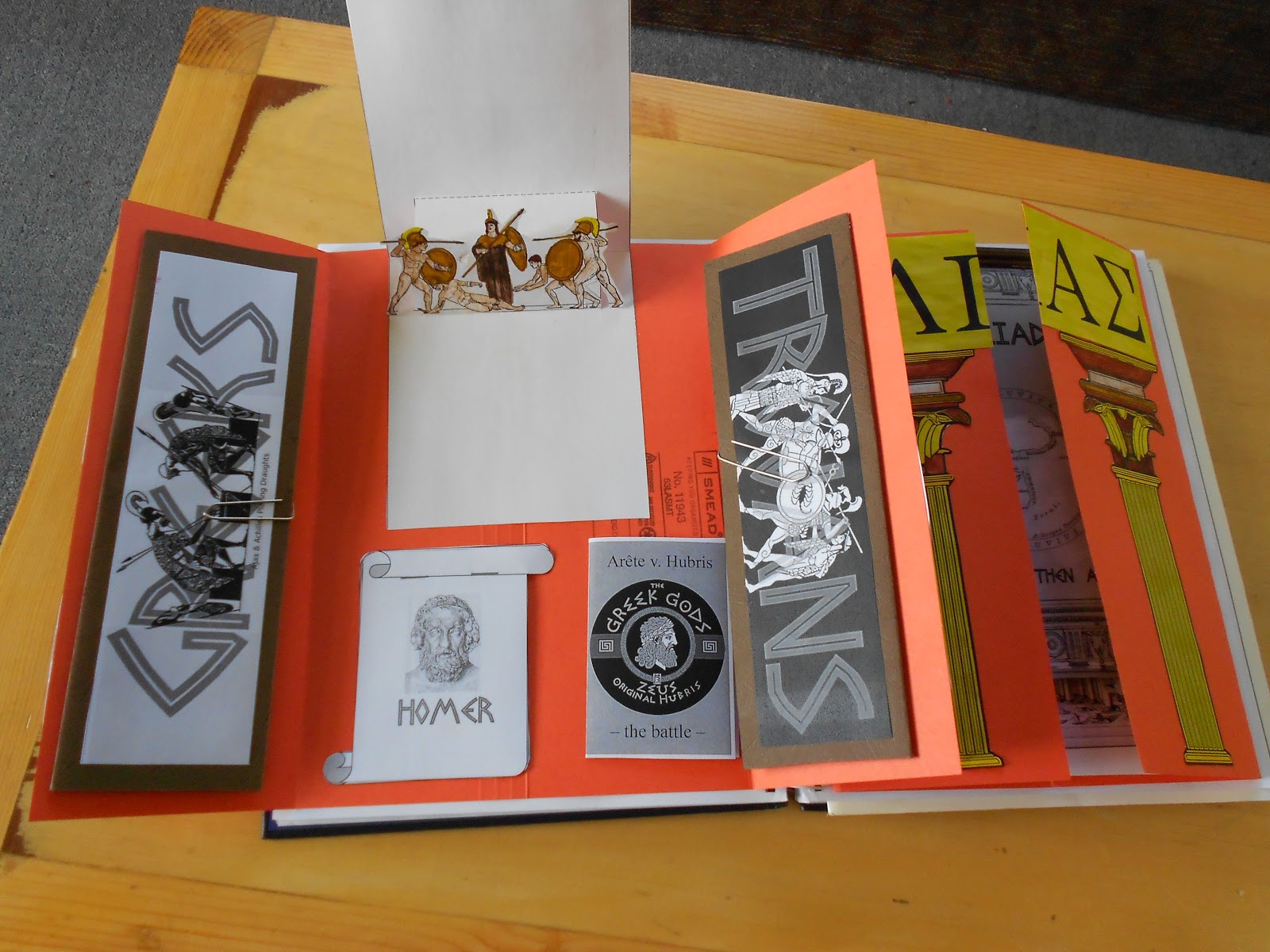
Much of my time this week has been spent preparing a lapbook centered around The Iliad by Homer. We have been reading Rosemary Sutcliff's version (Black ships Before Troy) of this epic poem which is actually written in a narrative form. On our next pass through this fascinating portion of history we will read the poem written by Homer.


To prepare the lapbook I print off the pages, cut them out and assemble parts that would be time consuming and irrelevant to the point of the book. Some things by doing them the boys will learn more about the story, other things are just busy work, I save them that. So once the mini books are ready I put them into a plastic pouch and save them for the boys. This time I fashioned the lap book to fit into our spiral bound scrapbook.


Just a glimpse of the mini books all out of the pocket.


The boys spent time coloring the pieces that made up the two front covers before we pasted them onto the cover and then into the spiral bound book. We limited the colors used to just browns and yellows to see how the colors will tie the whole lapbook together visually. This was an unpopular suggestion on my part and though the boys did it, they asked that they could decide on the colors next time. So though it looks great this way it is theirs and next time you will see the colors they choose.


Here is Zak's completed covers pasted in the notebook. We now have a lapbook in a note book. I am not sure if we are lapbooking or notebooking but probably the former rather than the latter. Either way it is working rather well. :)


We did put the mini books together and into place, but we have not yet written in them, colored them or done any sort of real study using them. In the end we will have understood better who killed who, who fought with the Trojans and who fought with the Greeks. We will know the family tree of the Greek gods and which gods played a part in this story. And last put the story on the map.


More entries made this week in the Aesop copywork book. Zak really caught onto this assignment and though I require only one fable a day he has been doing two or three hoping to get more and more treats for good handwriting. Very cute!

The boys are all sad that the Burgess Bird Book is drawing to a close. They are counting the pages that are left and savoring them. I suggested we read the book again, for there are so many things you can do to compliment this book and dig a little deeper into the information he so wonderfully presents about birds. I am strongly considering this but have not yet decided. What would you do? The boys were intrigued. I mean really, who said you can only read a book once? And then there are the issues brought up in my mind regarding illustrations and CM's methods. I like this quote from this article and am pondering just what part adding more to the reading of the story will play in their minds.
Our senses, it seems to me, are some of the tools we have for taking in information, but they are not the primary tools for learning.  This is a major problem in much of the world of education today.  There is much talk about learning styles, and I suppose it is helpful to know one’s learning style, but the fact is, taking information in is not the same as processing that information, or, as Mason said, “labouring with the mind.”   This is the step that many children never get to take in their learning process.  This is the purpose of narration, which Mason called “the act of knowing” (p. 17).  In fact, we may have preferences as to which sense we prefer to take in information (visually, kinesthetically, aurally, tactically, or odoriferously), but this is not the same as owning new information.  Mason says, “We trust much to pictures, lantern slides, cinematograph displays; but without labour there is no profit.” 
I'll tell you what I came up with next week. 

Another thing we completed this week: Memorized the Poem "A Secret." We did it the same we memorized the first poem, with drawing pictures, copywork and lots of reading and repetition. Now we are off to do some dictation the boy's favorite exercises. No really, it is!

We are getting to the end of Toad Triumphant too. This week seemed to be a week of many endings.  Thus I am soooo excited for next week which will be full of beginnings. :)


We veered away from the dialogues this week to look into the grammar of Latin. It was just a peek. I printed off cards with nouns (animals), cards with adjectives. The first day we simply played concentration with the animals to learn their names in latin.

On the second day we together matched the adjectives with the animals according to their gender. SImply collectively making up funny sentences with just the nouns and adjectives.

Then on the third day I hand printed two cards for each with the verbs we know thus far, erit (will be) and est (is). They first took the pile of adjectives and separated the masculine ones from the feminine ones, then I gave them each an animal and they created sentences matching the gender of the noun with the gender of the adjective. Then they read out their sentence in Latin and translated it to us using the words to help sheet below.


The cards for the animals and the adjectives were from the Minimus Teacher's guide, but the Words to Help sheet I made myself in Publisher.


To enhance the Klee inspired 3-D cities we painted last week we added some black lines, wow, they look so much better. These are Max's paintings.


Mostly this week we have been working on drawing and coloring 'inchies.' of Paul Klee's art works. Each square is 2 inches by 2 inches. We plan to make twelve in all and so far the boys have made 6 each, so we are halfway there.


Last week we finished reading A Day with Tchaikovsky so this week we listened to Tchiakovsky Comes to America a production by Classical Kids. Now onto a long look at the NutCracker Ballet. The boys will love this!

Lastly this week we went indoors to add an entry into our nature notebooks. Is wasn't because the weather was bad, but that it seemed a good time to add in a little skill training to our nature observation. We used basic contour drawings to develop the eye and train the coordination between what you see and what you draw. 


We did go out to get something to draw and then we drew the contour or outside edges of the specimen we selected. Then on another sheet of paper we tried a blind contour drawing looking only at the specimen and not at our papers. I did it first to show them how silly it will look and so they would not be afraid to just give it a go. This technique develops the best hand eye coordination needed for drawing. It was hilarious, fun and relaxed us all. Then they drew their specimen having had a good look at it now adding in as many details as we could see.


Hope your week was a good one too!

May 10, 2012

Just the Basics

Our school year is winding down. We have a few more things to wrap up in Egypt and in Astronomy and our artist study of Renoir is about half-way done. We finished all our other subjects including our phonics rule book and the second Elson reader, and now I have fun plans for the summer! We usually do school all year round unless we travel and it is just not possible...in the past that has been so, but this year even though we are traveling I have put together a "Just the Basics" homeschool for the road. It includes the three Charlotte Mason musts: Reading living books, narrating and copywork. We added some math. And simply for fun we are doing some nature study about bugs and birds and some art with Artistic Pursuits.

This is the 3R's bundle. In these two homemade books we get done math and reading, narration, and copywork. The boys keep the two books in their folders with a writing pen and we are set to go. A day of lessons looks like this:
  • The boys read the story to me and then tell back the story they read. (narrate).
  • Then they copy a sentence from the story. (see picture below)
  • Then we do two pages from Everyday Number Stories.
  • Then one day we do an art lesson, and then the next day nature study.
  • I still read aloud to them at night, this summer we are reading through The Moral Compass compiled by William J. Bennett and other books like Children of the Summer and nature stories by Arthur Scott Bailey
The fun part about being on the road is that other people get to help out with the schooling.

Grandma is helping Zak with his reading lesson.

Using Peter and Polly in Spring (Peter and Polly in Summer follows spring and will soon be available at Currclick) the boys practice reading aloud, and then they narrate the story back to me. Both Everyday Number Stories and Peter and Polly in Spring are bound with a Pro-Click Binder. If we stay on schedule we may get to read both Peter and Polly in Spring and Peter and Polly in Summer before next year.

After the boys read and narrate they then copy a sentence from the story on this pre-made copywork page which is included in the Peter and Polly e-book along with ideas for nature study and a coloring page. We decided to just use the copywork pages.

Each day we also do two pages from Everyday Number Stories. If you like Emma Serl's Primary Language Lessons you may want to try this math book as Emma Serl wrote Everyday Number Stories too! 
I simply love this book. It is the perfect bridge for us to recall the addition and subtraction work we did this last year and to then introduce simple multiplication and division. Along the way we get exposure to fractions, measurement, days of the week, money and time.
Everyday Number Stories introduces each new concept first with a story about Frank and Kate using the math concept in real life. In the story above Kate is buying ribbon and she is inroducung the concept of 3 feet = 1 yard. Then on the opposite page the problems focus on doing sums with the info from the story. each time doing number problems are within a span, like number under 12 or under 24 etc.  it increases as the book continues until all numbers up to 144 are worked.
I also love that it is FREE!! Find it here.

For fun we are reading living books about bugs and birds and getting out in nature to observe them.
Above are the following tools the boys have in their back packs for our nature study this summer.
  • Spiral bound notebook and a pen.
  • small water color book for small paintings and a small paper pad for drawings.
  •  a guide for bugs and a guide for birds. Pocket sized so they fit in their hands.
  • Binoculars
  • butterfly garden
  • a bug jar with a magnifying top
  • a butterfly net
  • sharp eyes
We just finsihed reading Children of the Summer which is a delightful story about Jean Henri Fabri. The story is told from the point of view of his son Paul as he watched his father play "tricks" on different insects to see what they would do when Paul was a little boy. The illustrations are also fabulous!

Also for fun we are going to do many of the art lessons in Artistic Pursuits Grade K-3 Book Three and Child-sized Masterpieces Modern School for steps 6 and 7. So we get to explore painting, sculpture, junk fabrication, computer art and pastels. It will be a wonderful way to review the impressionists/post-impressionists we studied last year and bridge over to the post-impressionists/modern artists we plan to look at next year. After we do the 3R's we will alternate between doing nature study or an art lesson. Until then we are finishing up the subjects from last yet still undone. I love how home schooling can be so flexible!
I am so looking forward to this new fun schedule. Now if the weather would only get warmer.

When we are not doing this new schedule we have been doing this...

Climbing on the rock wall at the local Aquatic Center and...

Taking swimming lessons. This is Zak coming up for air and a big smile!

February 26, 2012

Lit2go

We are not even half way through book two of the Elson Reader Series and I am planning what to do after we are done. I am weird, I know. I never used to be a planner but I am hooked on planning for education. It is so much fun to look at resources that are available out there, especially those that are FREE. In my search for what-to-do-next for our reading lessons I came across a really fun and useful site.

Have fun looking at lit2go. This site has a wonderful selection of classic literature for FREE! Best thing about this site is that it is so user friendly. Let me show you around a bit and gush about how great I think this site is.

The home page is laid out in such a way that it is easy to peruse their "shelves" and see what is available. It is not a huge selection but what they have selected is good quality literature. If you have a book in mind you want to look up simply click on the letter of the alphabet and see what titles there are under it. To see a book simply click on the picture of it.
On the book page you will note several useful bits of info.

• A short description of the story.

• Chapter titles links that link to a download page and a short description of that chapter is about.

• The Flesch-Kincaid readability level (in the right hand margin)
Once you click on the chapter title you will be offered the choice of downloading a PDF or an MP3. (not all of the books on this site have both but I noticed most do) The MP3’s are well read and they correspond with the text on the download page. If you chose to download the PDF you will not be disappointed. Here is a sample page from Little Bear at Work and Play.
NOW what I really like about this site is the Flesch-Kincaid grade levels. What is the Flesch-Kincaid grade levels? you ask: click on the words and find out or here is a short answer to way-lay your curiosity:


The Flesch-Kincaid Grade Level index is one way to measure and report the readability of English text. The Flesch-Kincaid formula considers the average number of words per sentence (average sentence length, or ASL) and the average number of syllables per word (ASW) within a given passage in order to estimate the complexity of the text. The formula then converts that complexity level into a score that roughly equates with a grade level (K-12) in the United States. The formula is:


Flesch-Kincaid Grade Level = (.39 × ASL) + (11.8 × ASW) - 15.59
I am excited about these levels because I am an intuitive sort of person and step-by step things are still a bit of a mystery to me. By using these levels I can be more sure that I am getting materials that will be within the range of what my boys can do and they won’t freak out when I assign something way too hard by mistake. (They like it when I follow the book)

At the top of the page click on the tab entitled “readability.” This will bring you to page with K-12 links on it. Each link/number takes you to books and passages of books that are readable at that level. We will be looking at level 3 once we finish our Elson Readers and here are some titles on our list to choose from:

Books:
Rescuing the Lost Balloonist by Captain Quincy Allen
Squinty the Comical Pig by Richard Barnum
Uncle Tom’s Cabin by Herriot Beecher Stowe (Told to Children)
Passages:
Hercules and the Waggoner by Aesop
One to make ready from counting and Math rhymes
The little Hero of Haarlem from Fairy Tales and other traditional stories
The Story of Miss Moppet by Beatrix Potter
Laughing Song a poem by William Blake
Seventh Night: Mr. Scarecrow from Seven O’Clock Stories
pages and pages more
 I could use these resources in a myriad of different ways here are some I am toying with:
• Select several passages/a book and print them out. Bind them into a reader using my pro-click binder (3-ring biders work well too!)  for each of the boys. It would be fun to let the boys select the passages they wanted to read so they have more of a part in the creation of the reader itself.


• Use parts of the passages for copywork. Since they are graded by level you be sure you were selecting simple passages at first and slowly build up to more difficult ones.


• Make a CD of some of the poems or stories to listen to on long car trips or before bed time.


• Read aloud once passage and have the boys narrate what was read.


 How would you use them? I would love to hear your ideas.

January 26, 2012

Yeah! They Are Reading!

Today, Zak and I had a giggle over the name of the fox in his story, “foxy woxy.” Every time he read it he jabbed me in the side with his elbow and giggled. I giggled too. Mostly I am giggling because Zak is reading, all my boys are reading and I am thrilled. I am also relieved. I have struggled with this subject since we began working on it two years ago. It is so nice to finally be over the hump. Now we are giggling and enjoying stories together. They don’t read perfectly, but that is part of the charm of it. There is something so precious in hearing the emerging reader sounding out words and getting a funny sort of rhythm to the telling. One of my boys shouts. Why, I don’t know, but it seems to help him keep on task. I am not complaining only reminding him he doesn’t have to shout when he reads.

My plan this year was to saturate them with little language lessons through out the time we ‘do school’ in the mornings. I had four different things I did on top of narration, and copywork. We did a lot of language arts each day. As we have been doing these I noticed that some of the lessons were really working, and some were not. So I have adjusted the plan.

Here is the old plan:

• Read a story from the Elson reader each day. Narrate the story they read.

• Write down and review on phonic rule each day.

• Two times a week do a lesson from Reading Reflex at the reading level.

• Two times a week do a reading lesson from Reading Made Easy, with worksheets from the activity book.

• Do copy work at least once each day in other subjects like history, music, or astronomy.

Here is the new plan:

• Read a story from the Elson reader each day. Narrate the story they read.

• Write down and review one phonic rule each day.

• Do one lessons worth of worksheets from the reading Made Easy activity book each day. That is about three to four simple worksheets.

• Do copy work at least once each day in other subjects like history, music, or astronomy.

If you look at the new plan you will have noticed we dropped the formal reading lessons from RME and RR. Those were the things I added because I was nervous they would have a few gaps in their learning if I did not do them. The things I kept the boys all WANTED to do and are using them to teach themselves what they need to know to read.


My oldest son wanted to do the phonics rules, so last year when he told me this I created the way we would do this, and it is working great. I posted two sheets one for the steps to do to complete the review sheet, and another sheet with the steps to write down the phonics rule for that day. They can do this lesson by themselves. Once they are finished the rule card and the review sheet, I check their work and they redo it if it did not meet the standard I have prescribed. It took only a few sloppy endeavors for them to realize it was more work to do it hastily than to do it right. :)

They all adored the worksheets so we kept those and copywork, well it is required by mom still.


My twins wanted to read through the Elson readers, so all three boys are doing just that. I was reluctant to do this at first because I thought they would not have enough words to be able to read it, and then they would be discouraged. But, they were determined and away they went. I had planned to do JUST the primary book this year, reading two or three times a week. And I had planned to use a few of the teacher’s guide activities on the days we did not read, but I soon saw that they needed to read every day and not to bother them with the teacher’s book stuff at all. They read every day and made quick time through the primary book and went on to book one. The stories are still simple but longer. They are just about to finish it, we begin book two next week. I am so proud of them!

I am beginning to see my boys owning their learning process. What fun that is! To see them chose materials for their reading lesson last year which will to get them to the goal of learning to read and then to watch them using those materials to do it is wonderful. It is a pleasure to see them succeeding and to know I had very little to do with it. Truly, I have been more like the parent steadying the bike as the child is learning to ride it. They are doing the work to ride, I am simply keeping them up until they do it. Now I watch as they are riding on down the block under the large elm trees soaring away into a whole new world.

January 3, 2012

Peter and Polly


Peter and Polly in Winter is a wonderful story written by Rose Lucia. It is one of the treasures I have found amongst the public domain books. The stories are about a little boy and a little girl as they live their lives on a small farm with their family and friends during the winter season. There are three other volumes, Peter and Pollly in the Spring, P and P in the Summer, and P and P in the Autumn. The stories as wholesome and winsome. When I read the first few chapters it dawned on me how cleverly they fit with Charlotte Mason's idea of nature study. I was intrigued. Could this little reader be helpful in nature study as well as reading practice, narration practice and copywork? Turns out it is not too bad. Might even work in the place of life skills too!

In this e-book you will find:

A cover page which can be printed on card stock for a durable start to your copywork book or your nature notebook...or both!

A Map of Peter and Polly’s village.

A 35 reading lessons for emerging readers. The original books were not graded but I would guess it is at the 2nd or 3rd grade level.

At the end of each reading lesson you will find:

Narration prompts. I have found that the best way to initiate narration practice for the new narrator is with material that the narrator has read for himself.

Copywork exercises. I have provided one sentence from the reading lesson for beginning writers using the primary lines and two or three sentences for those using regular lines. (There are blank pages at the end of the book if you want to make your own or do more work on this.)

A nature study prompt or activity that follows the thread of the story. (There are notebook pages at the end of the book if you don’t have a nature journal that you are already using)

A coloring page

I hope to be able to complete the whole series this year so that if we can follow Peter and Plloy through the seasons learning our CM langauge arts skills and doing some nature study and some life skills in the process.

May 5, 2011

A Charlotte Mason Reading Lesson


Reading…ughhh. Why can I never get my head around how to teach this? Why does my son hate to learn it? Why do all the methods and books work for other people and we are still struggling to find something…anything that will work at all? I thought this would be the best part of homeschooling, why have I failed when I care so much and I have tried so hard and followed all the instructions? Lord, what do I do now?


That was me last year. That was me before I stepped back, before I had the courage to trust Charlotte Mason and her ideas about teaching reading.

My son is bright, he learned his letters and their sounds on his own, he loved it, showed confidence in his ability to learn, then I stepped in and thought I would simply add to his great start and lead him on his way to reading by spending time with him everyday going through a book that was highly recommended. He would be one of those early readers. I was certain. I was wrong. I got in his way.

Then I tried Charlotte’s idea.

1. I Chose a passage of poetry or scripture that was interesting to my son. I made sure it has lots of long and interesting words in it.

2. I varied the reading lessons so he was is not bored with only decoding.

We do three different lessons with one line of the passage.
Sight word lesson: I give my son the words from the line of the passage we are on. I chose a word in that line and write it on a white board. I tell him what the word is. He then finds the word in his pile of word tiles. Then he studies it, turns it over and writes it in his notebook without looking at it. We do this with all the words in the line or until 20 minutes is up. Each time a new word is introduced he will read all the words we have learned thus far. Once the line is done we go on to the next lesson.

Build the story Lesson: I give my son the words from the line of the passage and either dictate the line to him and he builds it or he is given a written copy of the line and he build the story by himself. Then he copies the line into his notebook.

Building words lesson: I write on the board one of the words we learned in the previous sight-word lesson. For example I might have “twinkle.” I ask my son to read the word.

1. I say the word slowly and ask, “What do we have left if we take away tw?” Then I erase the beginning letter(s) and we get “inkle.”

2. Then I ask, “What would you add to “inkle” to get “tinkle?” My son would add a “t” to create the new word with his loose letters. Use the same process to make “sprinkle” and “wrinkle” and any other “inkle” derivatives that you can think of. We don’t have to do every possible combination. We just choose words that will mean something to us, and discuss them as you go along.

3. Then I write on the white board all the words he makes, forming them into a list which he reads aloud. We review this list in various orders as we go through the lesson.

4. Then we take turns making sentences with the words and he writes down his favorite sentence. Sometimes, for variety I have him simply write down the list of words that he made in his notebook.

5. We repeat this process with all the sight my son learned last time or 20 minutes is up. Then we continue again the next day.


“A child is interested in things, not words. His mind doesn’t yet analyze, but he is a keen observer. Nothing is too small for his notice. He can spy out the eye of a fly. Nothing is too intricate for him, and he loves puzzles. But what interests him is whatever he can find out by looking.” -Charlotte Mason


One of the brilliant things about Charlotte Mason’s method is that I the teacher get out of the way. My role is simply to “to indicate, stimulate, direct, and constrain to acquirement of knowledge.” My son makes his own relationship with the letters words, rules etc. using his own mind and way of learning.
Indicate: this is the lesson for today.

Stimulate: choose passages that I know will interest my son and he is able to do.

Direct: Your assignment is… you will have 15 minutes to work on it.

Constrain: teach the habit of attention, the habit of obedience, the habit of perfect execution

This year my son is reading reading, this year I am not in the way. This year we are both loving reading lessons. Thank you Charlotte, I wish I had trusted you sooner.


As a result of our success this year I created these reading lessons:

April 18, 2010

Blend Phonics

Last year I began to teach my 5 year old son to read. He is bright, articulate and had already learned the letters and their sounds by himself a year earlier, so I thought this is going to be a breeze. Boy was I wrong. I was just figuring out how this all goes together so I just stuck to the book I had on hand and felt confident it would be our path to success. After all it was a phonics based book and we believed phonics was the best route to reading. However, Max read the words backwards, he guessed a lot, and we had a very hard year. I decided he had dyslexia. Since I knew little about how to help someone with dyslexia, I prayed and waited for a way to approach it. I read The Gift of Dyslexia by Ronald D. Davis and many online articles but none of the information fit us.
This year my 4 year old twins (Zak and TJ) and my oldest (Max), now 6 years old, learned phonics together. By this time I had phoneme cards and allot of ideas about how to make learning the sounds hands-on, creative, and visual. We spent the first term playing with letters, making the letters in every way you can imagine, playing fun games, doing art and now all three are very good at letter recognition, their sounds etc. So then what to do…..Just about this time I opened up my email and noticed that freebie of the day was all new for this week, so I log on and discovered some thing there that was a God send for us. Because I subscribe there is a special freebie for me. (Anyone can subscribe for free…it is well worth the trouble) It was Don Potter’s website of remedial math, writing and reading materials. ALL FREE
If you knew me you would know that I am not the best in fundamentals, steps, details. So the Three R’s is not my forte. Now you will know why I was thrilled to find someone who could “staff my weakness”. Don Potter was just the man to help us. He has been teaching the Three R’s for years and has tried lots of approaches and seen something he calls whole words dyslexia reversed when phonics first instruction is implemented. Whole word dyslexia he explains comes about when the child is introduced to sight words, look say methods, when whole words are presented to decode, but direction of where to begin decoding is not reinforced, or when reading a word by guessing what it is by the context or pictures Is allowed or encouraged. I had been using a book which was supposedly phonics only….but we read funny styled letters, learned site words, and were asked to decipher meaning from context and were provided pictures to aide in comprehension. My 5 year old simply found decoding each sound tedious and thus chose the easier route of guessing and trying to memorize whole words.


Blend phonics was written by Hazel Loring an elementary teacher in the 1900’s. She taught for over 20 years. Here is what Mrs. Loring says:
"All of my teaching experience has confirmed my belief that directional guidance, inherent in the blend phonics system, is the key to success in teaching reading."


Don Potter adds:
“Hazel Loring's method is different from other phonics method I have seen. It is taught from the chalkboard or overhead. Students learn to blend the sounds of the letters from left to right, one after the other. They do not see the whole word at a glance; therefore, they are required to look at each letter in proper sequence. The blending is done in this order, for example "bat:" b-a, ba, ba-t, bat." Students are reading from the "sounds" rather than from the "meaning." I teach the letter names along with the sounds (phonemes) and spell the words as I write them on the board. The students are constantly reminded of Mr. Potter's Secret of Reading: "Look at all the letters the right way, and no guessing." Loring's "blend phonics technique" can actually be used with any phonics program. It has a precise way of teaching students to look at words (perceptual development); and from that viewpoint alone has serious theoretical value beyond its particular scope and sequence. The technique is of universal application.”


I have begun teaching all three boys using this little Blend Phonics booklet (25 pages). Don Potter has provided student reading books, a teachers manual, flash cards of all the words used so you can create games. See my other posts called up the ladder, break through and roll and read for how we used them. He has also provided decodable stories, a cursive version of the student text, progress charts and completion certificates. All for FREE!
What I love about blend phonics is the simple way so many things have been incorporated. At every step all the letters of the alphabet are used so the student practices all letter sounds at every step. For instance when reading through words with the short “a” sound the word list begins with bat, ban can etc ending with words like tad, quack, and zig-zag. So each sound is repeated multiple times for good practice.
I added a writing portion to the lessons because it reinforces the learning process by adding more senses and repetition. I bought startwrite a program for about $40 to create handwriting sheets in cursive of all the words they are reading. So our lessons are now more thorough. We read the words, write the words, and then play a game with the words at the end of each step. (about every two weeks)
There are Six steps in all progressing from simple decoding to more complex decoding. You can be through all six steps in four months. What a confidence booster for your young reader. At which point you can teach sight words, begin reading books and begin another more in depth set of phonics lessons called Word mastery if you like.


Step 1: Short vowels; Consonants
Step2: Consonant blends; diagraphs
Step3: Long Vowels (VCE)
Step 4: R-Controlled vowels
Step 5: Vowel diagraphs; Diphthongs
Step 6: Irregular spellings


Thus far I am pleased with the success of this with my boys. They are doing the short lessons I assign and seemingly thus far showing no signs of dyslexia. My oldest has begun to self correct his writing. My 4 year old kinesthetic random son is reading! What a timely gift from a God who sees my kids need for education, their mothers weaknesses to provide it, and gives us a gift we did not know we needed yet, and all for FREE!


If you would like to read more about whole word dyslexia and how to correct it and prevent it, or maybe you would like a more in depth explanation about how to teach reading I highly recommend Why Our Children Can’t Read by Diane McGuiness.